The uncomfortable truth about Google Ads agency certifications that most agencies won’t tell you
If you’re comparing Google Ads agencies, you’ve probably noticed a badge many agencies promote heavily: Google Premier Partner.
It’s often presented as proof that an agency is elite, highly skilled, or somehow better than other agencies.
But, here’s a question: Would you trust a restaurant more if it displayed a badge saying “We serve the most food in this city”?
Probably not. You’d want to know if the food was actually good.
Yet every day, businesses choose Google Ads agencies based on a badge that essentially says the same thing: “We manage the most ad spend.” That badge is Google Premier Partner status, and it’s displayed prominently on agency websites across the internet like a seal of approval.
The problem? It tells you almost nothing about whether that agency will actually deliver results for your business. At bureau42, we’re not in the business of selling you shiny badges. We’re in the business of telling you what actually matters. So, let’s cut through the marketing spin and talk about what Google Premier Partner status really means—and what it doesn’t.
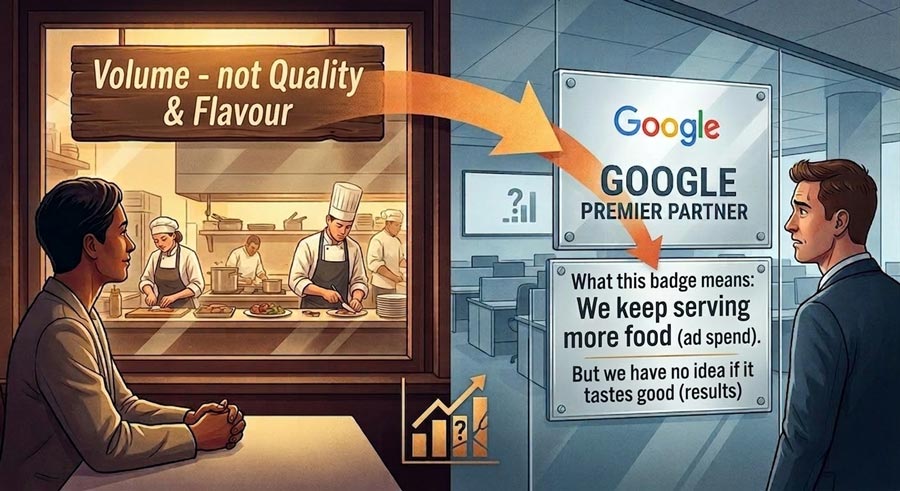
Premier Partners spend more money
What Google Partner Status Actually Measures
The Google Partner Program has three tiers: Member (basically anyone who signs up), Partner (agencies meeting baseline requirements), and Premier Partner (the top 3% based on performance metrics).
To become a standard Partner, agencies need:
- 70% optimisation score across managed accounts
- $10,000 USD in ad spend over 90 days
- 50% of strategists holding Google Ads certifications
Fair enough. Basic competency matters.
Premier Partner status, though? That’s where things get interesting. Google awards this to agencies based on five metrics:
- Existing client growth (year-over-year ad spend increases)
- New client acquisition
- Client retention rates
- Product diversification (spending across Search, YouTube, Display, Shopping, Apps)
- Total annual ad spend
Notice anything missing from that list? Your actual return on ad spend. Your conversion rates. Your cost per acquisition. You know, the metrics that actually determine whether your campaigns are successful. Google’s Premier Partner badge rewards agencies for doing one thing exceptionally well: growing Google’s revenue.
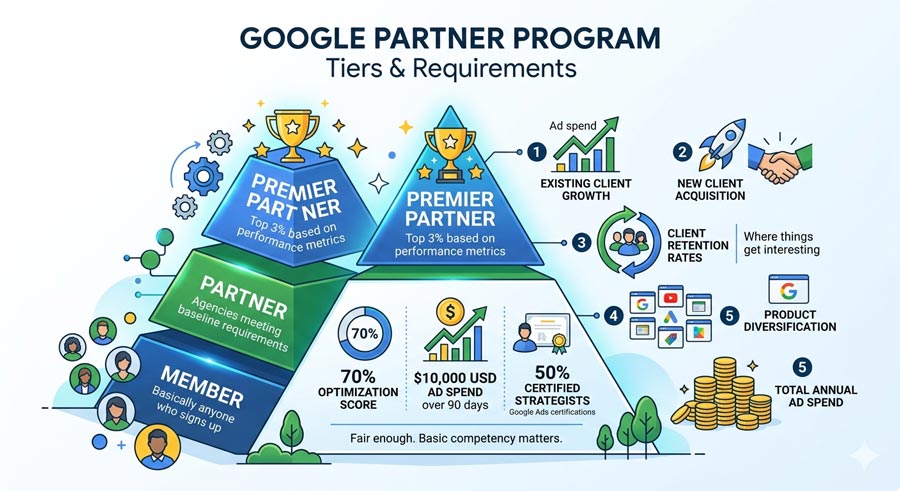
Google Partner Program Requirements
The Scale Trap: Why Premier Partners Favour Big Spenders
Let’s be blunt about what these metrics actually incentivise.
An agency gets Premier status by managing large budgets across multiple ad formats with high client retention. That structure naturally favours:
- Large clients with substantial budgets
- Encouraging clients to spend more year-over-year
- Pushing diversification into additional ad products (whether they make sense or not)
Here’s a real-world example: A focused agency that specialises in Search campaigns for local businesses could be delivering exceptional results—40% conversion rate improvements, 50% reduction in cost per lead—but they’ll never achieve Premier status because they don’t check the “product diversification” box.
Meanwhile, a Premier Partner managing mediocre campaigns across Search, Display, YouTube, and Shopping for dozens of clients with growing budgets gets the badge. Which agency would you rather work with?
The Small Business Problem
If you’re a small business spending $5,000–$15,000 monthly on Google Ads, Premier Partner agencies present three specific risks:
1. Misaligned Incentives
Premier Partners are incentivised to increase your spend and diversify your campaigns. You might need laser-focused Search campaigns that maximise efficiency from a limited budget. Those goals don’t always align.
As one agency owner specialising in small businesses puts it: “We try to keep Google Ads budgets as low as possible while delivering valuable leads our clients need.” That’s the opposite of what drives Premier status.
2. Attention Economics
Large Premier Partner agencies often manage hundreds of clients. Your $10,000 monthly account competes for attention with their clients spending $100,000+ monthly. Which accounts do you think get priority when the senior strategist’s time is limited?
3. Cookie-Cutter Strategy
At scale, agencies rely on standardised processes and junior team members. That’s efficient for them, but your business isn’t standard. You need someone who understands your specific market, customer journey, and competitive landscape—not someone applying a template.
What the “Exclusive Benefits” Actually Mean for You
Premier Partners love to highlight their exclusive perks:
Dedicated Google representatives.
Standard Partners get Google support too. One agency owner who let their Partner status lapse noted: “I’ve found [Google support] to be just as helpful as before.” Unless there’s a platform-level crisis, this advantage is overblown.
Early access to beta features.
New features typically roll out globally within weeks or months. The competitive edge is temporary. Plus, beta features often have bugs—being first isn’t always better.
Priority technical support.
If your agency needs to escalate technical issues to Google frequently, that’s actually a red flag. Great agencies solve most problems through strategic expertise and technical competence, not by calling in favours.
These perks sound impressive in a pitch deck. Their practical impact on your campaign performance? Minimal.
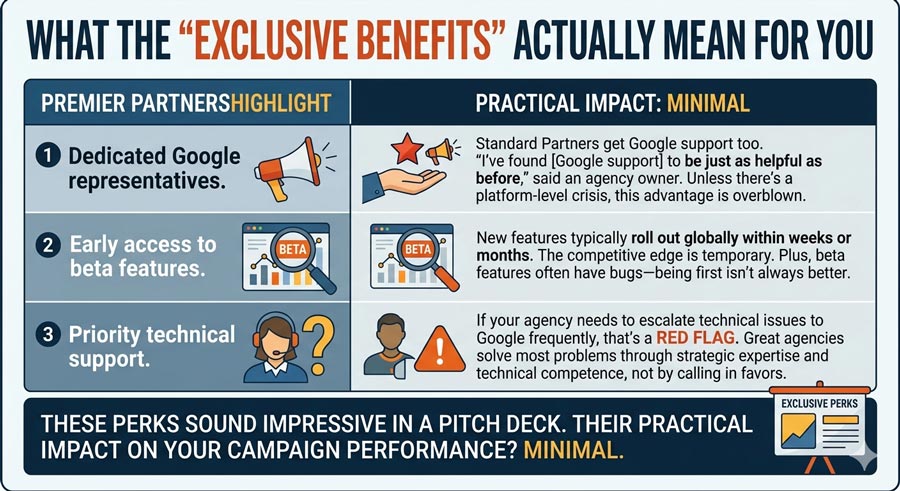
Premier Partners Highlight
What Actually Matters When Choosing a Google Ads Agency
Stop looking at badges. Start evaluating these factors:
Relevant Industry Experience
Have they worked with businesses in your sector? Do they understand your typical customer journey, average deal size, and competitive dynamics? A Premier Partner with zero experience in your industry is less valuable than a standard Partner who’s run 50 campaigns for businesses exactly like yours.
Strategic Methodology
How do they approach campaign strategy? Do they start by understanding your business goals, or do they jump straight into tactics? What’s their philosophy on budget allocation? How do they determine which ad formats make sense?
Listen carefully here. Agencies that immediately push multiple platforms and increasing budgets might be optimising for Premier status metrics, not your ROI.
Transparency and Reporting
Can they clearly explain what they do and why? Will you have direct access to the strategist managing your account? What does their reporting look like—and do they track the metrics that actually matter to your business?
Verifiable Results
Ask for case studies from similar businesses. Request specific metrics: conversion rate improvements, cost per acquisition changes, ROAS increases. Get references and actually call them. Ask those references: “What was the biggest challenge you faced working with this agency, and how did they handle it?”
Aligned Incentives
How is the agency compensated? If they earn a percentage of ad spend, they’re incentivised to increase your spending, whether it improves your results or not. Fixed fees or performance-based models align better with your objectives.
Questions to Ask Any Agency (Premier or Not)
Before you sign with any Google Ads agency, ask these questions and pay attention to the answers:
- “How many clients do you manage, and what’s the average account size?” (Understand where you fit in their portfolio)
- “Who will manage my account day-to-day, and can I meet them?” (Meet the actual person doing the work)
- “Can you show me case studies from businesses in my industry with similar budgets?” (Verify relevant experience)
- “How do you decide which ad formats and strategies to use?” (Test for strategic thinking vs. platform pushing)
- “What’s your client retention rate, and what are the main reasons clients leave?” (High retention could mean great results or locked-in contracts)
- “How are you compensated, and how does that align with my goals?” (Understand their incentives)
- “What happens if campaigns underperform in the first 90 days?” (Gauge their confidence and accountability)
The quality of their answers matters more than any badge on their website.
The bureau42 Take
We’re not saying Premier Partner agencies are bad. Some do excellent work. We’re saying the badge itself is a poor indicator of whether an agency is right for you.
Premier Partner status tells you an agency is large, manages substantial budgets, and keeps clients around. It doesn’t tell you:
- Whether they understand your business
- If they’ll give your account meaningful attention
- Whether their strategy aligns with your goals
- If they can actually deliver the results you need
At bureau42, we’ve seen boutique Partner agencies deliver exceptional results for clients who’d been disappointed by Premier Partners. We’ve also seen businesses thrive with Premier Partners after leaving smaller agencies.
The badge doesn’t determine the outcome. The match between your needs and the agency’s capabilities does.
Choose an agency based on their ability to achieve your specific business objectives, not on their ability to check boxes that increase Google’s revenue. Sometimes those align. Often they don’t. And if an agency leads with their Premier Partner badge rather than with questions about your business? That tells you everything you need to know about their priorities.
Ready to work with an agency that asks about your business goals before showing you their certifications? bureau42 builds data-driven Google Ads strategies focused on one metric: your growth. Let’s talk about what’s actually possible for your business.

Written by
Richard Wassell
“With 20+ years in digital marketing, Richard helps brands grow online through SEO, SEM, Google Ads, GA4, and compelling content. He combines technical know-how with practical strategies to deliver real results — all while keeping the human side of marketing front and centre.”