Why the Same Strategy Does Not Work Everywhere
Western Australia may be one state, but it is not one search market.
A business competing for customers in central Perth faces a very different digital environment from one operating in Bunbury, Busselton, Albany, Geraldton or the Pilbara. Search demand varies, competitors differ, customer expectations change and the meaning of “local” becomes more complex as distances increase.
That is why an SEO strategy developed for a Perth business cannot simply be copied, renamed and applied to regional WA.
Effective local SEO starts with understanding how customers in each market search, compare providers and decide who to contact. It must also reflect where a business genuinely operates, which services it can deliver, and which locations offer the strongest commercial opportunity.
Search Volume Is Only Part of the SEO Opportunity
Keyword research is an essential part of SEO, but monthly search volume should never be treated as the only measure of value.
Perth-based keywords usually attract more searches because the metropolitan area has a larger population and more businesses competing for attention. Terms such as “commercial electrician Perth”, “Perth family lawyer” or “accountant Perth” may generate significant demand.
However, these searches also attract:
- Established local competitors
- National brands and franchises
- Business directories and comparison websites
- Higher levels of ongoing SEO investment
- Customers who compare several providers before enquiring
Regional search terms often record lower volumes, but that does not make them commercially insignificant.
Someone searching for “commercial electrician Bunbury” or “accountant Busselton” may have fewer providers to choose from and a more immediate need. The keyword may generate only a fraction of the traffic of its Perth equivalent, but a higher percentage of those searches may turn into qualified enquiries.
Search volume tells you how often a phrase is used. It does not reveal the value of the work, the quality of the prospect or the likelihood that the user will contact a business.
For regional WA SEO, commercial intent often matters more than total traffic.
Perth SEO Operates in a More Competitive Market
Perth businesses generally compete in a more mature digital market.
For high-value services, the first page of Google may include established local businesses, national operators, directories, marketplaces and websites that have invested in SEO for years.
Ranking for broad Perth keywords may require:
- Strong service-page content
- Established website authority
- High-quality backlinks
- Effective internal linking
- Consistent technical SEO
- Positive local reviews
- Regular content development
- Ongoing conversion optimisation
Smaller businesses may struggle if they try to target every service and every Perth suburb at the same time.
A better approach is to prioritise the services, industries and locations that offer the strongest balance of demand, profitability and realistic ranking potential.
For example, a specialist commercial cleaning company may achieve better results by targeting specific industries or service types instead of competing broadly for “cleaners Perth”. A professional-services firm may also perform better by creating detailed pages for its most profitable services rather than relying on one general services page.
The objective is not to attract every possible visitor. It is to become more visible to the customers the business is best positioned to serve.
Regional WA SEO Is Not Necessarily Easier
Regional WA businesses may face fewer direct competitors, but that does not mean regional SEO is simple.
A Bunbury business may compete with companies in Australind, Harvey and Busselton, as well as Perth operators willing to travel south. Businesses in mining regions may also compete with national suppliers, industry directories and large contractors with substantial marketing budgets.
Regional search results can be dominated by websites that are not physically based in the area but have stronger authority, better content or more established search visibility.
To compete effectively, a regional business must do more than mention a town name on a webpage. Its website should show that the company understands the market and can genuinely deliver the service.
Useful information may include:
- Towns and regions serviced
- Travel or mobilisation arrangements
- Delivery areas and timeframes
- Regional project experience
- Emergency response capabilities
- Local staff or facilities
- Industry-specific knowledge
- Environmental or operating conditions
A Perth contractor targeting the Pilbara, for example, should explain how it manages mobilisation, remote access, accommodation, equipment availability and response times.
Without this detail, a page may attract regional traffic but fail to give potential customers enough confidence to enquire.
Website Structure Should Match the Real Service Area
Location targeting is one of the clearest areas where Perth SEO and regional WA SEO should differ.
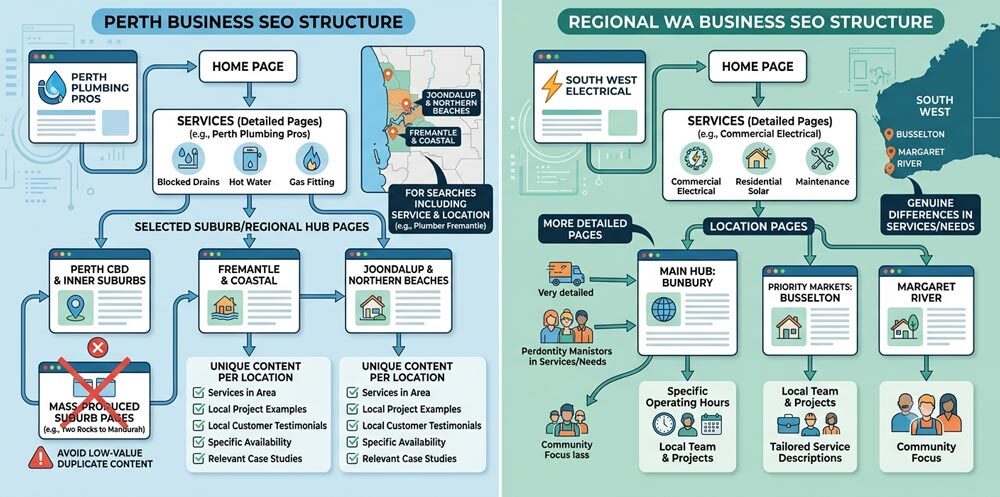
A Perth business may need a website structure that combines detailed service pages with selected suburb or regional hub pages. This can help the business appear for searches that include both a service and a location.
However, this does not mean creating a page for every suburb between Two Rocks and Mandurah.
Mass-produced location pages that repeat the same content while changing only the suburb name provide little value to users. They can also reduce the overall quality of the website when they are created mainly to capture rankings.
Each location page should have a clear purpose and include information that matters to customers in that area.
A useful Perth location page may cover:
- Services available in the area
- Local project examples
- Common customer or property types
- Travel or appointment availability
- Relevant testimonials
- Links to related services and case studies
Regional businesses may need fewer location pages, but those pages should be more detailed.
A Bunbury-based business serving the broader South West may have one strong Bunbury page supported by separate pages for Busselton, Margaret River or other priority markets where services, customer needs or operating arrangements genuinely differ.
The website architecture should reflect the business’s actual footprint, not an aspirational list of every town in Western Australia.
Local Proof Builds Trust and Improves Conversions
Customers do not choose a business simply because it appears in Google.
Once they reach the website, they need proof that the company is credible, experienced and capable of delivering what it promises.
This is especially important in regional communities, where local knowledge, reputation and word-of-mouth recommendations often carry significant weight.
Strong local credibility signals include:
- Case studies from recognisable locations
- Testimonials from regional customers
- Photographs of completed projects
- Information about local team members
- Community partnerships and sponsorships
- Experience in important regional industries
- Evidence of long-term operations in the area
A generic claim such as “we service regional WA” is far less persuasive than a detailed case study showing how the business solved a specific problem for a customer in Bunbury, Albany or Karratha.
These signals can support SEO by creating useful, location-specific content. More importantly, they improve conversion by giving prospective customers a reason to trust the business.
SEO should not stop once someone reaches the website. Visibility only creates value when it contributes to a meaningful action.
Google Business Profile Strategies Also Need to Differ
Google Business Profile plays a major role in local visibility, particularly for searches that trigger map results.
In Perth, businesses may compete against dozens of nearby operators. Profile optimisation should therefore focus on accurate categories, detailed service information, strong review quality, recent reviews, high-quality photographs and consistent business details.
Regional businesses may face fewer listings, but accuracy remains essential.
A regional Google Business Profile should clearly communicate:
- The genuine business location
- Areas serviced
- Opening hours
- Contact details
- Primary services
- Relevant photographs
- Recent customer feedback
Businesses should not create false offices, virtual addresses or misleading listings in towns where they have no legitimate presence.
For service-area businesses, the Google Business Profile and website should work together. The profile introduces the business in local search results, while the website provides the information customers need before making an enquiry.
Content Should Reflect Local Questions and Conditions
The same content calendar will not work for every WA market.
Perth customers often have more providers to compare, so they may research several options before making contact. Relevant content may include:
- Service comparisons
- Pricing and budgeting guides
- Product or solution alternatives
- Industry-specific advice
- Suburb or property considerations
- Questions to ask before choosing a provider
Regional customers may be more concerned about availability, logistics and service delivery.
Useful regional content may cover:
- Whether the business services a specific area
- Travel or call-out costs
- Delivery timeframes
- Remote servicing arrangements
- Seasonal demand
- Regional climate conditions
- Equipment durability and maintenance
- Access to support outside Perth
A South West tourism operator may publish content about seasonal travel, local events and itineraries. A Pilbara equipment supplier may focus on heat, dust, remote support and operational reliability.
This type of location-specific content can also support visibility in AI-driven search because it provides clear, experience-led answers to specific customer questions.
SEO Success Should Be Measured Commercially
Perth and regional SEO campaigns should not be judged against identical traffic targets.
A regional campaign may attract fewer visitors but generate a stronger conversion rate because the audience is more relevant. A Perth campaign may deliver more organic sessions but require more conversion optimisation to turn that traffic into enquiries.
Useful SEO performance measures include:
- Qualified phone calls
- Contact and quote requests
- Organic conversion rate
- Lead location
- Service requested
- Google Business Profile actions
- Visibility for priority commercial searches
- Lead quality
- Sales or revenue influenced by organic search
Rankings and traffic remain useful indicators, but they should not be the final measure of success.
The commercial question is whether SEO is helping the business reach the right customers and generate sustainable growth.
Businesses Serving Multiple WA Markets Need a Segmented SEO Strategy
Businesses operating across Perth and regional WA need an integrated strategy, but the execution should not be identical in every location.
A practical approach is to:
- Conduct separate keyword research for each priority market.
- Assess the competitors appearing in each location.
- Confirm which services are genuinely available in each area.
- Identify differences in customer needs and buying behaviour.
- Create distinct content where those differences are meaningful.
- Use regional projects and testimonials to build credibility.
- Track enquiries by location and service.
- Prioritise markets according to commercial value and delivery capacity.
This avoids spreading resources across dozens of weak location pages while ensuring priority markets receive the content and optimisation needed to compete.
Local SEO Must Be Genuinely Local
Perth SEO generally requires stronger authority, clearer differentiation and disciplined prioritisation. Regional WA SEO depends more heavily on genuine service coverage, local credibility and a clear understanding of how customers operate outside the metropolitan area.
Neither market should be treated as a larger or smaller version of the other.
With teams across Perth, Bunbury and Busselton, bureau42 understands that businesses compete differently depending on their location, industry and growth objectives.
The focus should not be on producing more content or generating more traffic for its own sake. It should be on building a structured search strategy that improves visibility, attracts qualified prospects and delivers measurable commercial results.
Is your current SEO strategy aligned with the markets you actually serve? Speak with bureau42 about developing a locally informed SEO strategy built around qualified leads, accountability and sustainable growth.

Written by
Richard Wassell
“With 20+ years in digital marketing, Richard helps brands grow online through SEO, SEM, Google Ads, GA4, and compelling content. He combines technical know-how with practical strategies to deliver real results — all while keeping the human side of marketing front and centre.”